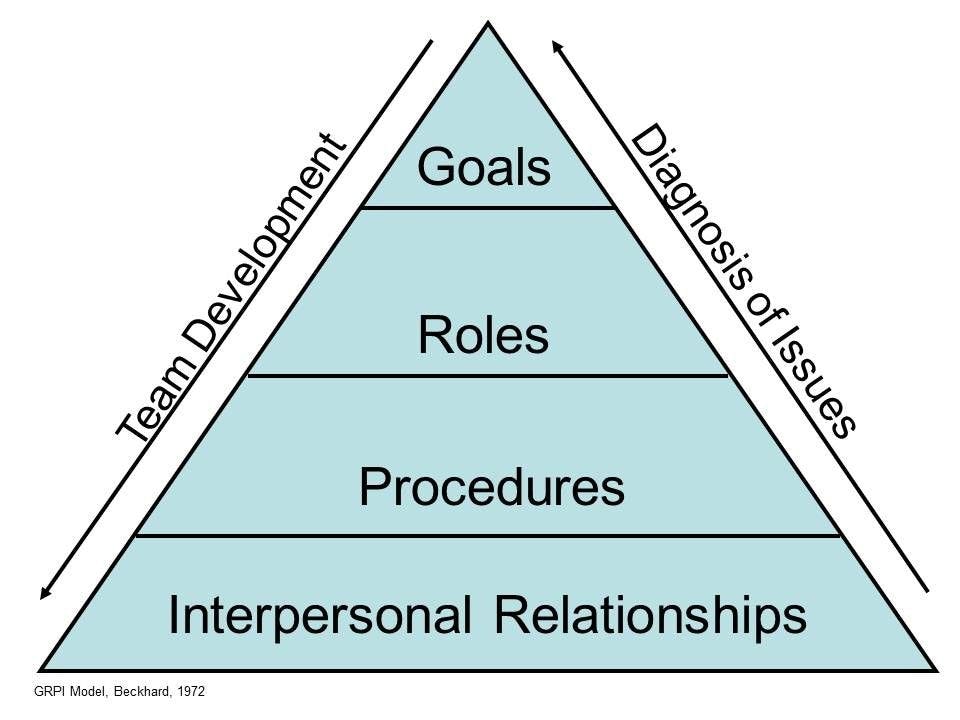
Nobody ever built a statue to a committee, but great leaders do build cohesive teams. This should come as no surprise. Strong collaboration is a building block of success and what distinguishes effective teams from dysfunctional groups is well known: Richard Beckhard’s GRPI model describes how clear, aligned Goals are the single biggest contributing factor towards high performance. Yet many established organisations struggle to build real teams in a digital age, leaving them vulnerable against more fleet-footed insurgents.
There are pros and cons to being ‘big’. While it is generally easier for young companies to move quickly without legacy tech, products and distribution networks, it’s equally true that many incumbents can draw on resources and brand loyalty that should enable them to defend market share as conditions change. Yet successful companies all too often become ponderous and distracted. I believe this is, at least partly, due to conventional approaches to scaling, which incentivise siloed-thinking and the growth of departmental fiefdoms. As cohesion declines, Project Management Offices (PMOs) and other lattice-like structures are introduced to stitch things together by exception. Cross-functional goal-setting and effective teamwork is impeded.
Let’s compare conventional, project-focused set-ups with mission-led teams to see how teamwork is affected:
Conventional / project
Output focussed: let’s get things over the line.
Funding secured via annual budget cycle
PMO tasked with delivering pre-agreed scope to time and budget. The ‘Iron triangle’ - but quality is not defined by business/ user impact
Executive Sponsor likely to have vested interest, but not responsible for execution
Project manager ‘on the hook’ for delivery, but not fulfilment of business case
Contributing stakeholders (the ‘doers’) provide input around day jobs. They represent different departments or business units and are expected to protect these interests
Formal, theatrical communications support governance model and mitigate lack of stakeholder access
Mid-flight learning carries risk: may drive ‘Change Requests’
Post-delivery funding and strategy not properly covered in business case
Majority of participants move on swiftly after launch. Next project begins.
Modern / product
Outcomes focussed: success defined by customer impact and results accrued for business.
Leaders judged on strategy and value delivery
Team members focused on the product - this is not a ‘side of desk’ encumbrance
Objectives shared. This encourages problem solving and evidence-based decision making
Little and often communication is possible and preferred
Increased understanding viewed as an opportunity, not a threat
Go-to-market is the beginning of the story, not the end.
Of course, even when goals are aligned, complicated programmes may benefit from the additional layer of coordination offered by Project Managers. And this is certainly not an argument for endless research and wandering: great product teams are dynamic, user-orientated and business savvy. But, when contributors are allowed to focus and objectives are shared, forward motion is maximised.
What can we do?
It’s hard to change organisational dynamics - especially when things seem to be going well. But, as Product Managers, we have an obligation to advocate for Outcomes over Outputs and showcase the power of cross-functional working and goal-alignment. We must evangelise for real ‘teams’ because they are drivers of sustainable business performance and great customer experiences.
This article was first published on Product Breaks.